Legands of the Jews > Volume 2 >
JOSEPH'S MAGNANIMITY
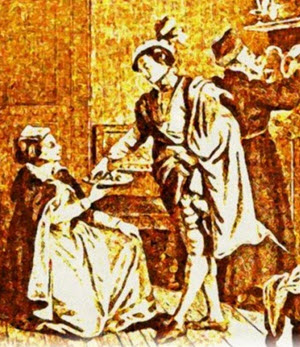
As Joseph was returning from the burial of his father in the Cave of Machpelah, he passed the pit into which his brethren had once cast him, and he looked into it, and said, "Blessed be God who permitted a miracle to come to pass for me here!" The brethren inferred from these words of gratitude, which Joseph but uttered in compliance with the injunctions of the law, that he cherished the recollection of the evil they had done him, and they feared, that now their father was dead, their brother would requite them in accordance with their deeds. They observed, moreover, that since their father was no more, Joseph had given up the habit of entertaining them at his table, and they interpreted this as a sign of his hatred of them. In reality, it was due to Joseph's respect and esteem for his brethren. "So long as my father was alive," Joseph said to himself, "he bade me sit at the head of the table, though Judah is king, and Reuben is the first-born. It was my father's wish, and I complied with it. But now it is not seemly that I should have the first seat in their presence, and yet, being ruler of Egypt, I cannot yield my place to any other." He thought it best therefore not to have the company of his brethren at his meals.
But they, not fathoming his motives, sent Bilhah to him with the dying message of their father, that he was to forgive the transgression and the sin of his brethren. For the sake of the ways of peace they had invented the message; Jacob had said nothing like it. Joseph, on his part, realized that his brethren spoke thus only because they feared he might do harm unto them, and he wept that they should put so little trust in his affection. When they appeared, and fell down before his face, and said, "Thou didst desire to make one of us a slave unto thyself. Behold, we all are ready to be thy servants," he spoke to them gently, and tried to convince them that he harbored no evil design against them. He said: "Be not afraid, I will do you no harm, for I fear God, and if ye think I failed to have you sit at my table because of enmity toward you, God knows the intentions of my heart, He knows that I acted thus out of consideration for the respect I owe to you."[427]
Furthermore he said: "Ye are like unto the dust of the earth, the sand on the sea-shore, and the stars in the heavens. Can I do aught to put these out of the world? Ten stars could effect nothing against one star, how much less can one star effect anything against ten? Do you believe that I have the power of acting contrary to the laws of nature? Twelve hours hath the day, twelve hours the night, twelve months the year, twelve constellations are in the heavens, and also there are twelve tribes! You are the trunk and I am the head--of what use the head without the trunk? It is to my own good that I should treat you with fraternal affection. Before your advent, I was looked upon as a slave in this country--you proved me a man of noble birth. Now, if I should kill you, my claims upon an aristocratic lineage would be shown to be a lie. The Egyptians would say, He was not their brother, they were strangers to him, he but called them his brethren to serve his purpose, and now he hath found a pretext to put them out of the way. Or they would hold me to be a man of no probity. Who plays false with his own kith and kin, how can he keep faith with others? And, in sooth, how can I venture to lay hand upon those whom God and my father both have blessed?"[428]
As Joseph's dealings were kind and gentle with his brethren, so he was the helper and counsellor of the Egyptians, and when Pharaoh departed this life, Joseph being then a man of seventy-one years of age, the king's last wish was that he might be a father unto his son and successor Magron, and administer the affairs of state for him. Some of the Egyptians desired to make Joseph king after the death of Pharaoh, but this plan met with opposition on the part of others. They objected to an alien on the throne, and so the royal title was left to Magron, called Pharaoh, according to the established custom the name given to all the Egyptian kings. But Joseph was made the actual ruler of the land, and though he was only viceroy in Egypt, he reigned as king over the lands outside of Egypt as far as the Euphrates, parts of which Joseph had acquired by conquest. The inhabitants of these countries brought their yearly tribute to him and other presents besides, and thus did Joseph rule for forty years, beloved of all, and respected by the Egyptians and the other nations, and during all that time his brethren dwelt in Goshen, happy and blithe in the service of God. And in his own family circle Joseph was happy also; he lived to act as godfather at the circumcision of the sons of his grandson Machir.
His end was premature as compared with that of his brethren; at his death he was younger than any of them at their death. It is true, "Dominion buries him that exercises it."[429] He died ten years before his allotted time, because, without taking umbrage, he had permitted his brethren to call his father his "servant" in his presence.[430]