Legands of the Jews > Volume 4 >
DANIEL
The most distinguished member of the Babylonian Diaspora was Daniel. Though not a prophet, (76) he was surpassed by none in wisdom, piety, and good deeds. His firm adherence to Judaism he displayed from his early youth, when, a page at the royal court, he refused to partake of the bread, wine, and oil of the heathen, even though the enjoyment of them was not prohibited by the law. (77) In general, his prominent position at the court was maintained at the cost of many a hardship, for he and his companions, Hananiah, Mishael, and Azariah, were envied their distinctions by numerous enemies, who sought to compass their ruin.
Once they were accused before King Nebuchadnezzar of leading an unchaste life. The king resolved to order their execution. But Daniel and his friends mutilated certain parts of their bodies, and so demonstrated how unfounded were the charges against them.
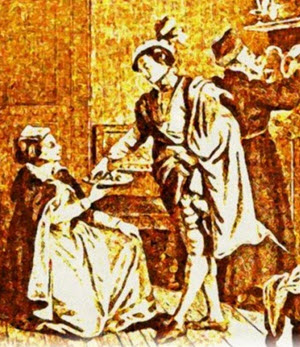
As a youth Daniel gave evidence of his wisdom, when he convicted two old sinners of having testified falsely against Susanna, as beautiful as she was good. Misled by the perjured witnesses, the court had condemned Susanna to death. Then Daniel, impelled by a higher power, appeared among the people, proclaimed that wrong had been done, and demanded that the case be re-opened. And so it was. Daniel himself cross-questioned the witnesses one after the other. The same questions were addressed to both, and as the replies did not agree with each other, the false witnesses stood condemned, and they were made to suffer the penalty they would have had the court inflict upon their victim.
Daniel's high position in the state dates from the time when he interpreted Nebuchadnezzar's dream. The king said to the astrologers and magicians: "I know my dream, but I do not want to tell you what it was, else you will invent anything at all, and pretend it is the interpretation of the dream. But if you tell me the dream, then I shall have confidence in your interpretation of it."
After much talk between Nebuchadnezzar and his wise men, they confessed that the king's wish might have been fulfilled, if but the Temple had still existed. The high priest at Jerusalem might have revealed the secret by consulting the Urim and Thummim. At this point the king became wrathful against his wise men, who had advised him to destroy the Temple, though they must have known how useful it might become to the king and the state. He ordered them all to execution. Their life was saved by Daniel, who recited the king's dream, and gave its interpretation. (80) The king was so filled with admiration of Daniel's wisdom that he paid him Divine honors. Daniel, however, refused such extravagant treatment he did not desire to be the object of idolatrous veneration. (81) He left Nebuchadnezzar in order to escape the marks of honor thrust upon him, and repaired to Tiberias, where he build a canal. Besides, he was charged by the king with commissions, to bring fodder for cattle to Babylonia and also swine from Alexandria. (82)