Legands of the Jews > Volume 4 >
THE FLIGHT OF JONAH
Among the many thousands (23) of disciples whom Elisha gathered about him during the sixty years (24) and more of his activity, the most prominent was the prophet Jonah. While the master was still alive, Jonah was charged with the important mission of anointing Jehu king. (25) The next task laid upon him was to proclaim their destruction to the inhabitants of Jerusalem.
- The doom did not come to pass, because they repented of their wrong-doing, and God had mercy upon them. Among the Israelites Jonah was, therefore, known as "the false prophet." When he was sent to Nineveh to prophesy the downfall of the city, he reflected: "I know to a certainly that the heathen will do penance, the threatened punishment will not be executed, and among the heathen, too, I shall gain the reputation of being a false prophet." (27) To escape this disgrace, he determined to take up his abode on the sea, where there were none to whom prophecies never to be fulfilled would have to be delivered.
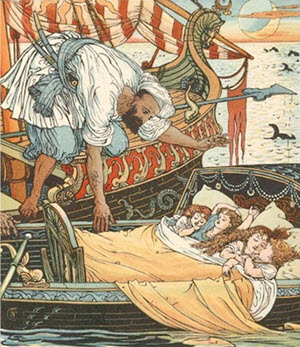
On his arrival at Joppa, there was no vessel in port. To try him, God cause a storm to arise, and it carried a vessel back to Joppa, which had made a two days' journey away from the harbor. The prophet interpreted this chance to mean that God approved his plan. He was so rejoiced at the favorable opportunity for leaving land that he paid the whole amount for the entire cargo in advance, no less a sum than four thousand gold denarii. After a day's sailing out from shore, a terrific storm (28) broke loose. Wonderful to relate, it injured no vessel but Jonah's. Thus he was taught the lesson that God is Lord over heaven and earth and sea, and man can hide himself nowhere from His face.
On the same vessel were representatives of the seventy nations of the earth, each with his peculiar idols. They all resolved to entreat their gods for succor, and the god from whom help would come should be recognized and worshipped at the only one true God. But help came from none. Then it was that the captain of the vessel approached Jonah where he lay asleep, and said to him: "We are suspended 'twixt life and death, and thou liest here asleep. Pray, tell me, to what nation dost thou belong?" "I am a Hebrew," replied Jonah. "We have heard," said the captain, "that the God of the Hebrews is the most powerful. Cry to Him for help. Perhaps He will perform such miracles for us as He did in days of old for the Jews at the Red Sea."
Jonah confessed to the captain that he was to blame for the whole misfortune, and he besought him to cast him adrift, and appease the storm. The other passengers refused to consent to so cruel an act. Though the lot decided against Jonah, they first tried to save the vessel by throwing the cargo overboard. Their efforts were in vain. Then they placed Jonah at the side of the vessel and spoke: "O Lord of the world, reckon this not up against us as innocent blood, for we know not the case of this man, and he himself bids us throw him into the sea." Even then they could not make up their minds to let him drown. First they immersed him up to his knees in the water of the sea, and the storm ceased; they drew him back into the vessel, and forthwith the storm raged in its old fury. Two more trials they made. They lowered him into the water up to his navel, and raised him out of the depths when the storm was assuaged. Again, when the storm broke out anew, they lowered him to his neck, and a second time they took him back into the vessel when the wind subsided. (29) But finally the renewed rage of the storm convinced them that their danger was due to Jonah's transgressions, and they abandoned him to his fate. He was thrown into the water, and on the instant the sea grew calm. (30)