Legands of the Jews > Volume 4 >
THE SHUNAMMITE
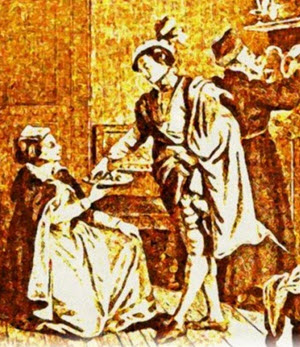
The great woman of Shunem, the sister of Abishag and wife of the prophet Iddo, (10) also had cause to be deeply grateful to Elisha. When Elisha came to Shunem on his journey through the land of Israel, his holiness made a profound impression upon the Shunammite. Indeed, the prophet's eye was so awe-inspiring that now woman could look him in the face and live. (11) Contrary to the habit of most women, who are intent upon diminishing their expenses and their toil, the Shunammite took delight in the privilege of welcoming the prophet to her house as a guest. She observed that not even a fly dared approach close to the holy man, and a grateful fragrance exhaled from his person. "If he were not so great a saint," she said, "and the holiness of the Lord did not invest him, there were no such pleasant fragrance about him." That he might be undisturbed, she assigned the best chambers in the house to the prophet. He on his part, desiring to show his appreciation of her hospitality, knew no better return for her kindness than to promise that she should be blessed with a child within a year. (12) The woman protested: "O, my husband is an old man, nor am I of an age to bear children; the promise cannot be fulfilled." Yet it happened as the prophet had foretold. Before a twelvemonth had passed, she was a mother.
A few years later her child died a sudden death. The mother repaired to the prophet, and lamented before him: "O that the vessel had remained empty, rather than it should be filled first, and then be left void." The prophet admitted that, though as a rule he was acquainted with all things that were to happen, God had left him in the dark about the misfortune that had befallen her. With trust in God, he gave his staff to his disciple Gehazi, and sent him to bring the boy back to life. But Gehazi was unworthy of his master. His conduct toward the Shunammite was not becoming a disciple of the prophet, and, above all, he had no faith in the possibility of accomplishing the mission entrusted to him. Instead of obeying the behest of Elisha, not to speak a word on his way to the child of the Shunammite, Gehazi made sport of the task laid upon him. To whatever man he met he addressed the questions: "Dost thou suppose this staff can bring the dead back to life?" The result was that he forfeited the power of executing the errand with which he had been charged. Elisha himself had to perform the miracle. The prophet uttered the prayer: "O Lord of the world! As Thou didst wonders through my master Elijah, and didst permit him to bring the dead to life, so, I pray Thee, do Thou perform a wonder through me, and let me restore life to this lad." (13) The prayer was granted, and the child was revived. The act of the prophet proves the duty of gratitude in return for hospitality. Elisha did not attempt to resuscitate his own kith and kin who had been claimed by death; he invoked a miracle for the sake of the woman who had welcomed him kindly to her house. (14)