Medieval Libraries and Manuscripts
As time went on, greater comfort was introduced. The windows of the walk of the cloister where the presses stood, usually the walk next the Church, were glazed—and sometimes not merely[Pg 21] with white glass, but with mottoes alluding to the authors whose works were near at hand; while in some monasteries the elder monks were provided with small wooden studies, called "carrells." A description of the whole system has been preserved for us in that curious book The Rites of Durham; but it must be remembered that this represents the customs of the convent just before the suppression, and therefore gives no idea of the rigour of an earlier time.
Part of the north walk of the cloister, Durham.
In the north syde of the Cloister, from the corner over against the Church dour to the corner over againste the Dorter dour, was all fynely glased from the hight to the sole within a litle of the grownd into the Cloister garth. And in every wyndowe iij Pewes or Carrells, where every one of the old Monks had his carrell, severall by himselfe, that, when they had dyned, they dyd resort to that place of Cloister, and there studyed upon there books, every one in his carrell, all the after nonne, unto evensong tyme. This was there exercise every daie.
All there pewes or carrells was all fynely wainscotted and verie close, all but the forepart, which had carved wourke that gave light in at ther carrell doures of wainscott. And in every carrell was a deske to lye there[Pg 22] bookes on. And the carrells was no greater then from one stanchell of the wyndowe to another.
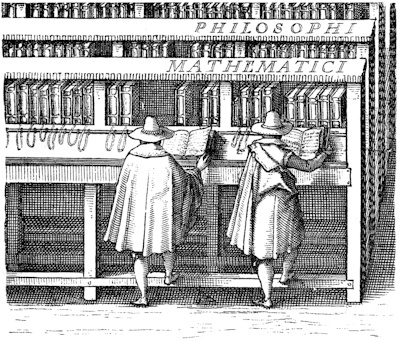
And over against the carrells against the church wall did stande certaine great almeries [or cupbords] of waynscott all full of bookes [with great store of ancient manuscripts to help them in their study], wherein did lye as well the old auncyent written Doctors of the Church as other prophane authors with dyverse other holie mens wourks, so that every one dyd studye what Doctor pleased them best, havinge the Librarie at all tymes to goe studie in besydes there carrells.
No example of an English monastic book-press has survived, so far as I have been able to discover; but it would be rash to say that none exists. Meanwhile I will shew you a French example of a press, from the sacristy of the Cathedral at Bayeux, but I cannot be sure that it was originally intended to hold books. M. Viollet-Le-Duc, from whom I borrow it, decides that it was probably made early in the thirteenth century.
Cupboard from sacristy of Bayeux Cathedral.
The Durham Rites speak only of book-presses standing in the cloister against the walls;[Pg 23] but it was not unusual to have recesses in the wall itself, fitted with shelves, and probably closed by a door. Two such are to be seen at Worcester, immediately to the north of the chapter-house door. Each is about ten feet wide by two feet deep.
Book-recess, east walk of the cloister, Worcester.
A similar receptacle for books seems to have been contemplated in Augustinian Houses, for in the Customs of the Augustinian Priory of Barnwell, written towards the end of the thirteenth century, the following passage occurs:
The press in which the books are kept ought to be lined inside with wood, that the damp of the walls may not moisten or stain the books. This press should be divided vertically as well as horizontally by sundry partitions, on which the books may be ranged so as to be separated from one another; for fear they be packed so close as to injure each other, or delay those who want them.