Medieval Libraries and Manuscripts
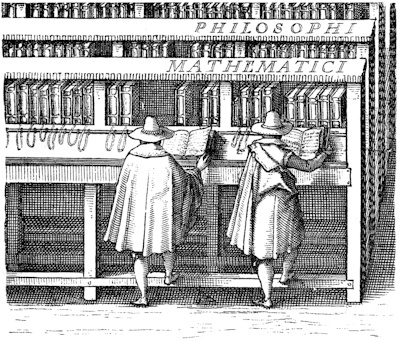
Book-cupboard and desk at Bolton, Lancashire. The former is lettered: "The gift of Mr James Leaver, citison of London 1694."
and at All Saints Church, Hereford, a collection of books bequeathed in 1715 was chained to ordinary shelves set against the walls, as may still be seen. This very obvious way of disposing of books evidently shocked old-fashioned people, for Cole the antiquary, writing in 1703, could still speak of the arrangement of shelves against the walls as à la moderne.
The libraries I have been describing were more or less public, and I should like, before I conclude, to shew you how books were bestowed in the studies of individual scholars—whether royal, monastic, or secular.
I conceive that for many centuries after the beginning of the Christian era the methods of the[Pg 55] ancient world were followed; and that private libraries were arranged upon the Roman model in presses, with busts, mottoes, and the like. Such was the library of Isidore, Bishop of Seville (601-636). He was a voluminous writer, and seems to have had a voluminous library, divided, if I interpret the arrangements correctly, among fourteen presses, each ornamented by one or more portrait-busts or medallions with suitable verses beneath them. The series concludes with a notice Ad interventorem, a person whom we may call A talkative intruder:
Non est hic quod agas, garrule, perge foras.
How useful such an admonition would be in modern libraries, if only it could be enforced!
So late as the end of the twelfth century I find a Bishop who bequeathed his library to a church describing it as "the contents of my press (plenarium armarium meum)."
Next: The Library at the Louvre