Medieval Libraries and Manuscripts
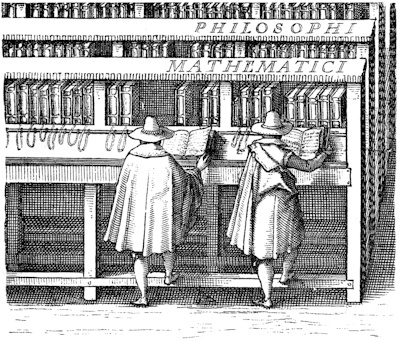
Merton College, Oxford: (1) general view of the interior of the Library; (2) a single bookcase as at present.
The system of chaining, as adopted in this country, would allow of the books being readily taken down from the shelves, and laid on the desk for reading. One end of the chain was attached to the middle of the upper edge of the right-hand board; the other to a ring which played on a bar set in front of the shelf on which the book stood. The fore-edge of the books, not the back, was turned forwards. A swivel, usually in the middle of the chain, prevented tangling. The chains varied in length according to the distance of the shelf from the desk. The bar was kept in place by a rather elaborate system of iron-work attached to the end of the bookcase, and secured by a lock which often required two keys—that is, the presence of two officials—to open it. To illustrate this I will shew you a sketch of[Pg 43] one of the bookcases in Hereford Cathedral (fig. 4).
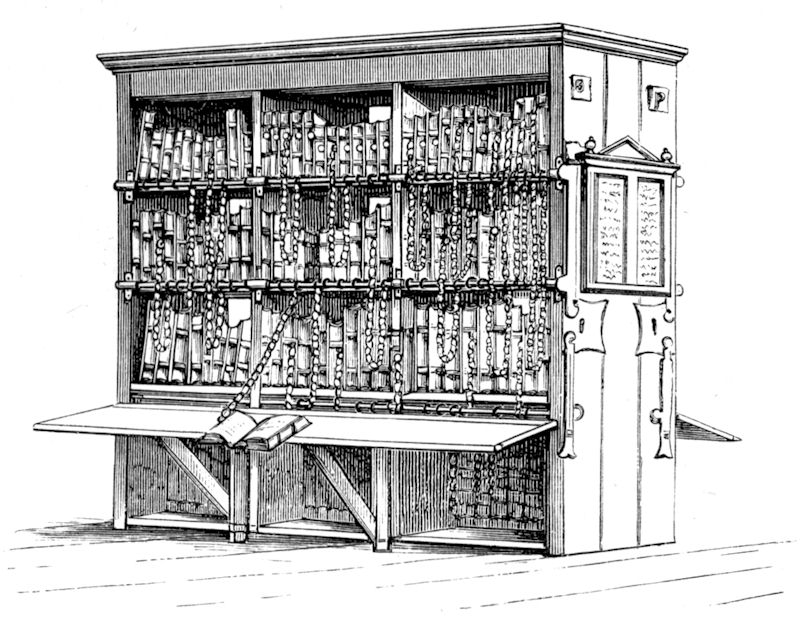 Fig. 4. Bookcase in Hereford Cathedral. (Lent by the Syndics of the University Press.)
Having said thus much about chaining, I return to the Merton bookcases. Cases similar to these were evidently in use in the library of Christ Church, Canterbury, where the memoranda I mentioned record four shelves—that is, two on each side—in each bookcase, and also at Clairvaux, where a similar feature[Pg 44] was observed. The design was evidently much admired, for we find cases on a similar plan, but larger, elsewhere in Oxford, as at the Colleges of Corpus Christi, S. John's, Trinity, Jesus, and in the Bodleian Library.
Next: Trinity College Library