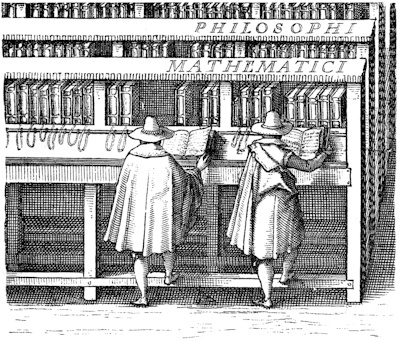
Gradually, however, other methods came[Pg 56] into fashion, due probably to the introduction of the handsome bindings of which I have already spoken. Some particulars have fortunately been preserved of the cost of fitting up a certain tower in the Louvre between 1364 and 1368, to contain the books belonging to Charles the Fifth of France, from which much useful information may be extracted. The fittings of the older library in the palace on the Isle de la Cité were to be taken down and altered, and set up in the new room. Two carpenters are paid for "having taken to pieces all the cases (bancs) and two wheels (roes), that is revolving desks, which were in the king's library in the palace, and transported them to the Louvre...; and for having put all together again, and hung up the cases (lettrins) in the two upper stages of the tower that looks toward the Falconry, to put the king's books in; and for having panelled ... the first of those two stories all round inside." Next a wire-worker (cagetier) is paid "for having made trellises of wire in front of two casements[Pg 57] and two windows ... to keep out birds and other beasts (oyseaux et autres bestes) by reason of, and protection for, the books that shall be placed there."
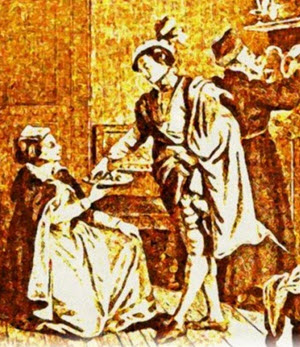
The words bancs and lettrins, which I have translated "cases," are both frequently used. The first commonly denotes the cases in monastic libraries, and the second is the usual word for a reading-desk. I think, therefore, that the two words were applied to describe the same piece of furniture, as "stall" and "desk" were with us. I am now going to shew you two pictures of rooms arranged for study, which fit the above description very well. The first is from a French translation of Boccaccio, Des cas des maleureux nobles hommes et femmes, written and illuminated in Flanders for King Henry the Seventh[2]. Two gentlemen are studying at a revolving desk, which can be raised or lowered by a screw. This is evidently the "wheel" of the French king's library. Behind are their books, either [Pg 58]resting on a desk hung against the wall (which is panelled), or lying on a shelf beneath the desk. The second is also Flemish, of the same date, from a copy of the Miroir historial[3]. It represents a monk, probably the author of the book, writing in his study. Behind him are three desks, one above the other, hung against the wall, with books, as in the first picture, resting upon them.
Next: Medieval Writing Desks